Aha! Roadmaps vs. Productboard: How do they compare? Explore what to look for in top roadmap software in 2026.
Aha! Roadmaps vs. Productboard: How to choose the best roadmap software


Roadmapping is not just about laying out delivery dates. It is how product teams connect strategy to the work they choose to build — clarifying priorities, aligning stakeholders, and making better decisions about what will create value for customers. The roadmap software you choose should make that work easier, more visible, and more effective as your team grows.
It is a strategic choice. So you need a tool you can trust. And as product development shifts rapidly with AI, you also want confidence in the company behind that software.
In 2026, the best roadmap software balances reliability and rapid innovation. It should offer your product team a stable foundation to build on while you evolve and accelerate your approach.
Strategic clarity has always been central to roadmapping. It is arguably even more critical now. With AI, the path from strategy to plan is compressed. As you deliver faster, you need to ensure that increased speed results in added value. You can do this by maintaining a clear connection to business goals and customer needs in everything you build.
Maintaining that connection is much harder when strategy, feedback, prioritization, and delivery happen in separate tools. Without shared context across the workflow, teams can move faster — but with less clarity about what matters and why.
Since you are reading this, you might already be rethinking what you need from your roadmap software. You might also be trying to understand what Productboard's recent Spark announcement, its shift to an AI-only approach, and ensuing layoffs mean for teams that currently use its roadmapping capabilities.
Aha! Roadmaps and Productboard are roadmapping tools that differ fundamentally. Here is what you should know.
Let's walk through how Aha! Roadmaps and Productboard compare and what the differences mean for your team's approach to roadmapping. We will start with a brief overview of each.
What is Aha! Roadmaps?
Aha! Roadmaps is purpose-built roadmapping software for product development teams. It covers the entire scope of roadmap planning — helping you set strategy, capture ideas, prioritize features, manage releases, and communicate visual plans to stakeholders in one place. Included in every Aha! Roadmaps plan is Elle, an AI assistant embedded throughout the software.
Aha! Roadmaps is our core roadmap planning product. It includes Aha! Ideas for customer feedback management, Aha! Whiteboards for visual collaboration, and Aha! Knowledge for product documentation. It is also part of a broader, integrated suite that includes innovative tools for product discovery, AI application development, and agile delivery.
About the company
Aha! was founded in 2013 as a bootstrapped company. Soon after, we launched Aha! Roadmaps: the first strategic roadmapping tool for product managers (which also established this software category). We remain fully self-funded, profitable, and stable today, and we have grown to support more than 1 million users at many of the world's best-known companies.
What is Productboard?
Productboard is a product management platform with a focus on helping teams collect feedback, prioritize features, and build roadmaps. The platform serves customers ranging from growth-stage startups to large enterprises.
Productboard Spark, currently in beta, is the company's separate AI tool for product managers. It is a standalone agentic experience designed primarily for generating detailed specs with added customer context.
About the company
Productboard is the company behind the tool of the same name. Founded in 2014, the company has raised more than $260 million in venture capital funding. Like many VC-backed software companies, it has gone through multiple workforce reductions in recent years.
What to look for in roadmap software
Product development teams should look for a roadmap tool that balances planning depth with capabilities to help you pinpoint what customers need and move quickly to deliver it with AI. That means your roadmap software should include:
Complete roadmapping and reporting: So you can connect strategy, feedback, and plans in one place — with the clarity and structure to manage work across teams and products
Customer feedback management: So you can identify customer needs and factor them into your roadmap decisions
AI integration: So you can move faster and make smarter decisions across every part of your roadmapping workflow (prototyping capabilities are especially useful, too)
The company behind your roadmap software should also prioritize rapid innovation — with a proven track record of regularly delivering product updates and listening to customers. That way, you can take advantage of new capabilities and feel certain that the vendor will be there for you in the future.
Aha! Roadmaps and Productboard are both well-known roadmap software options for product development teams. But they support different approaches, with meaningful differences across these key areas. We will look at those more closely in the next sections.
Key features: Complete roadmapping and reporting
Strategic planning is the core of what roadmap software should help you do. That means delivering on the essentials — helping teams prioritize, visualize, and communicate product plans — while providing visibility into progress at scale.
Aha! Roadmaps
Aha! Roadmaps is built for end-to-end planning — bringing strategy, ideation, prioritization, roadmapping, and handoff to development together in one place. Teams can create tailored roadmaps at any level (e.g., by initiative, team, or portfolio) and customizable progress reports. Work scales seamlessly with a flexible workspace hierarchy that rolls up goals, plans, and progress across the organization.
Aha! Roadmaps also covers essentials such as Gantt charts and capacity planning — so teams can manage dependencies and set release timelines they can actually deliver on. Plus, customer feedback management, collaborative whiteboards, and rich product documentation are included, as well as dedicated support from product management experts.
Our roadmap software is the core product within our suite of AI-powered product development tools, which encompasses additional tools for product discovery, agile delivery, AI prototyping and app development, and flexible project management. Together, the portfolio provides everything product managers and broader cross-functional teams need to deliver exceptional outcomes.
Productboard
Productboard is designed for creating simple, user-friendly roadmaps and prioritizing customer feedback. It includes solid roadmap visualization with different view options, plus OKR tracking. It also includes a small set of built-in reports. But it offers less depth for teams that need custom roadmaps, advanced reporting, and delivery planning — especially when more teams and products are involved.
Key features: Customer feedback management
Customer feedback plays a key role in shaping what belongs on your roadmap. The best roadmap tools make it easy to capture, organize, and act on what customers are telling you.
Both Aha! Roadmaps and Productboard offer ways to collect customer feedback directly in portals or through integrations with third-party tools. Both tools enable product teams to use AI to analyze feedback at scale and uncover trends and actionable insights.
In the past, some descriptions positioned Productboard as the more "feedback-centric" option. But Aha! software now far exceeds what Productboard offers for product discovery, feedback collection, and prioritization capabilities. It is also worth noting how differently each tool handles the flow of customer input in general.
Aha! Roadmaps
Feedback starts with the customer. Aha! Roadmaps includes Aha! Ideas Essentials, so customers can submit ideas, vote, and comment within a portal. Product managers then review for strategic alignment — using AI to synthesize and surface top priorities — and promote the best ideas directly to features on the roadmap. You can also close the feedback loop by automatically notifying customers when their ideas ship.
Aha! Ideas Advanced takes this further by adding more ways to collect feedback, including polls, dynamic forms, and in-app widgets. You can automate idea review, then segment feedback by different criteria (such as company size or location) and run AI analysis to understand the revenue potential.
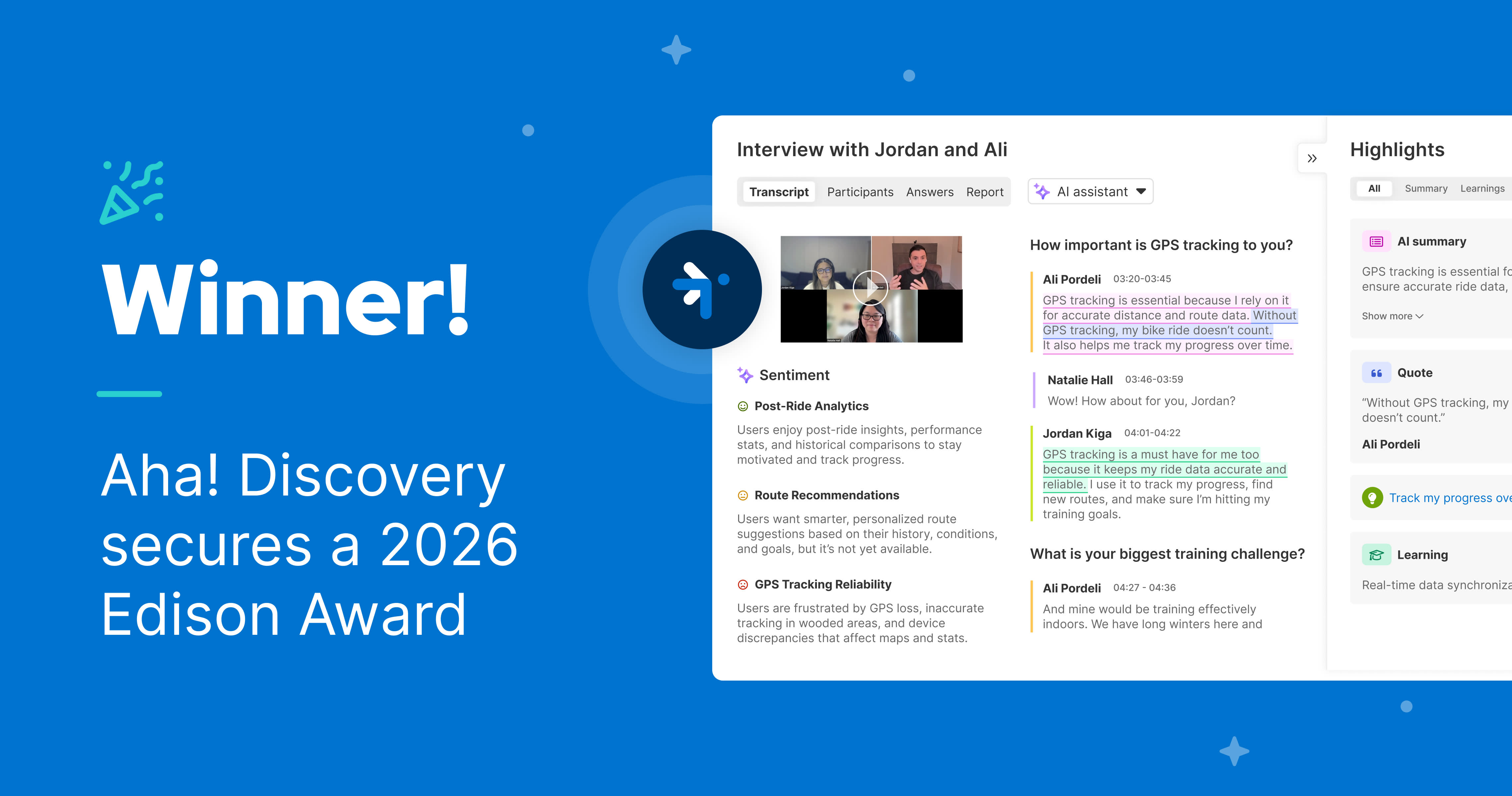
When you add Aha! Discovery, you can also manage your own customer research. You start by building a participant database and coordinating outreach for user interviews. Then, run transcript analysis and AI-powered insights reports so you can connect key learnings from those conversations to your roadmap — just as you would with customer-submitted ideas.
Productboard
Product managers curate feedback. Insights are submitted by customers, logged internally, or aggregated from external sources. Then, product managers analyze, formulate ideas, and publish them for customers to vote on. This gives teams more control over feedback intake, but adds work for the product manager and more distance between raw customer input and what gets prioritized.
Key features: AI integration
Most roadmap software now includes some AI features. But research, data analysis, and writing assistance are table stakes. What separates the best tools is how deeply AI is woven into the planning process itself. It is also important that the company behind the tool is actively advancing its AI capabilities — innovating new ways to help teams surface strategic opportunities and adapt to AI-driven methods of working.
Aha! Roadmaps
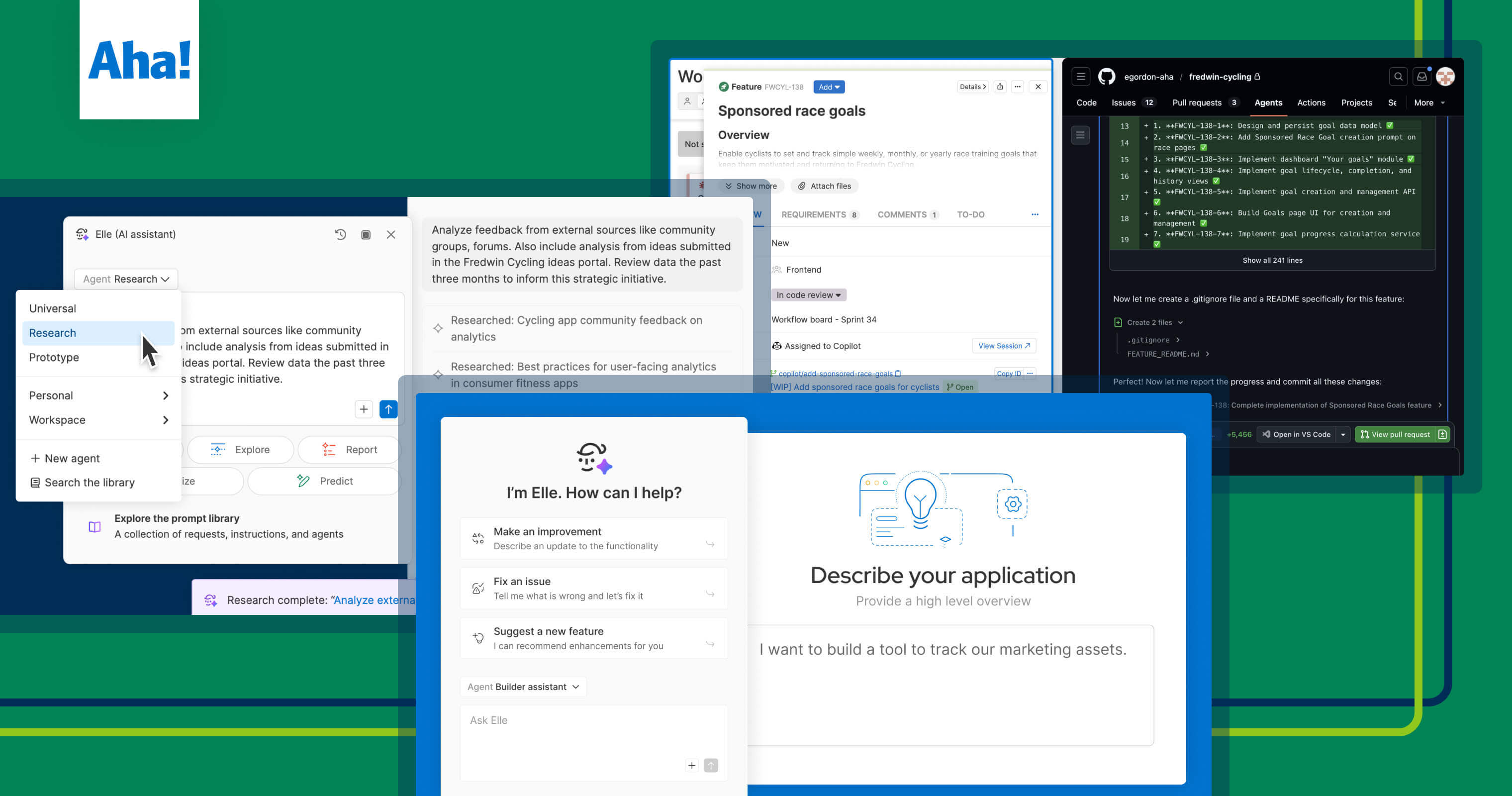
Elle, the built-in AI assistant in Aha! Roadmaps, is fully integrated throughout the software. Elle takes all your product data into account and can help you:
Deeply research your market, competitors, and personas
Suggest strategic opportunities, then draft strategy, goals, and initiatives
Review large volumes of customer feedback, summarize themes, and spot top ideas
Generate interactive whiteboard wireframes and feature prototypes
Draft requirements, calculate capacity, and map out a delivery plan
Reference, create, and analyze roadmap progress reports
Elle is equipped with an AI library of 100+ prompts designed specifically for product development. Teams can also build custom agents and instructions to fit their specific workflows.
Productboard
Spark is a standalone AI agent for tasks like creating product briefs, analyzing customer feedback, and researching competitors. It includes 150+ customizable prompts. Productboard has said it plans to integrate Spark more deeply into the broader product over time, but this is still in early stages.
Key AI feature: AI prototyping for product managers
The ability to create software prototypes from simple text prompts is one of the most powerful AI features for product managers. You can move from idea to design on your own — allowing you to validate concepts earlier and make better decisions about what belongs on the roadmap.
Aha! Roadmaps
Elle can create various kinds of prototypes, from low to high fidelity. Product managers can use Elle to generate lightweight prototypes on whiteboards for early discovery or build fully interactive prototypes right from a feature description.
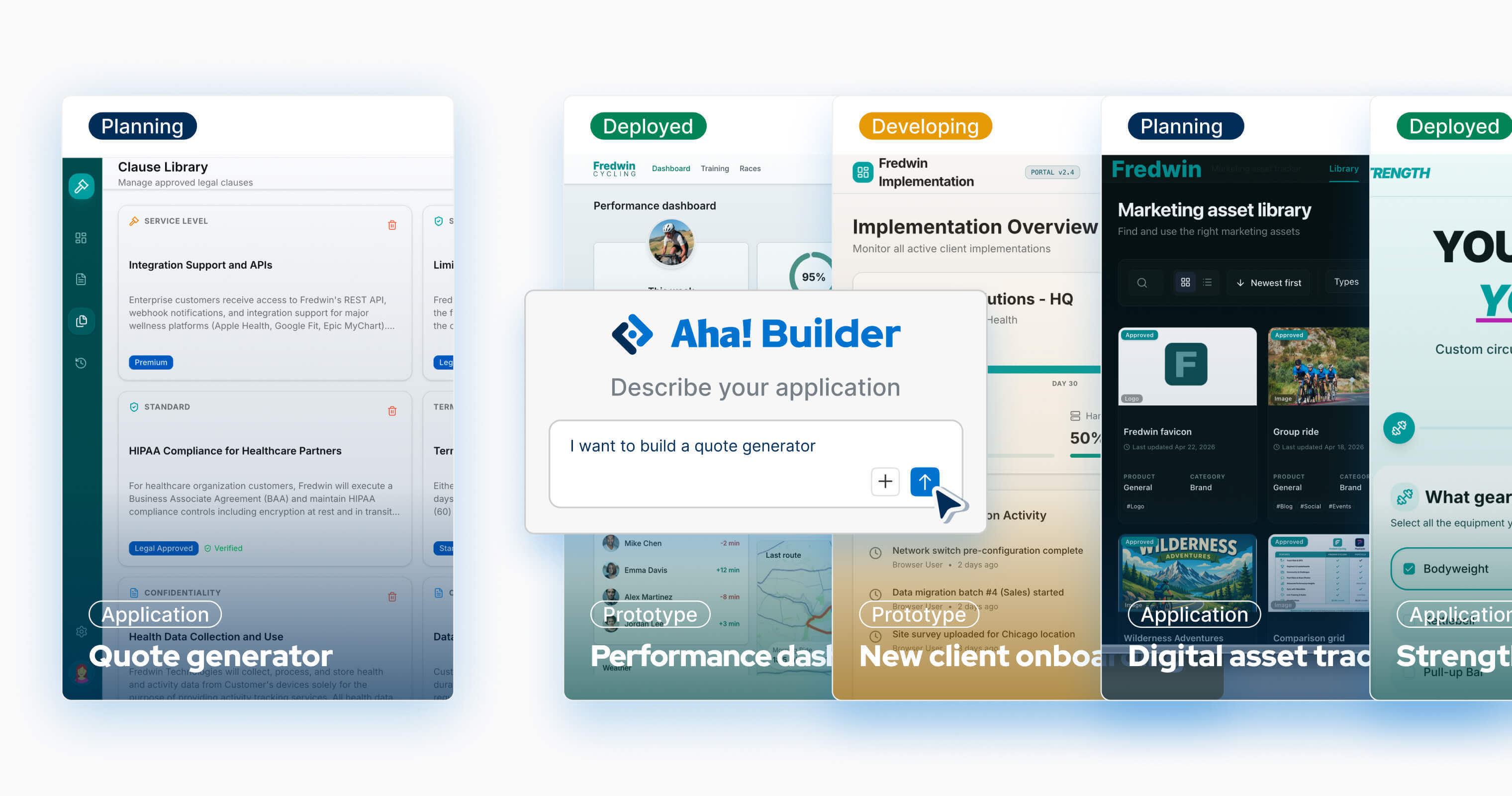
Aha! Roadmaps also integrates with Aha! Builder — our tool for creating business applications with AI. This lets you build prototypes that match your brand and are backed by a database. You can deploy these prototypes to production so your customers can test out the new experience (and when you are ready, even launch it as its own application).
Productboard
AI prototyping is not currently supported.
Aha! Roadmaps vs. Productboard: Feature comparison
Now, let's take a broader view of how Aha! Roadmaps and Productboard compare across several essential roadmap software features.
Aha! Roadmaps | Productboard | |
Strategy | ✅ Connects goals and initiatives to releases, epics, and features ✅ Multiworkspace hierarchy — progress rolls up across teams, products, and portfolios ✅ Supports strategic artifacts, including vision, positioning, personas, and competitors | ⚠️ Connects objectives and initiatives to features with OKR tracking only ❌ No workspace hierarchy — limited visibility for large multiproduct organizations |
Roadmap planning and sharing | ✅ Highly customizable roadmap views for strategy, releases, features, and more. ✅ Shareable via live presentations, webpages, and documents ✅ Reviewers and viewers can create saved views — working from the same data without needing full access | ⚠️ Multiple roadmaps with timeline, column, and grid views, but limited options for customization. ✅ Shareable via link or embed code ❌ No presentation builder ⚠️ Ability to create and save views is limited to paid maker seats — viewers cannot create their own |
Delivery planning | ✅ Supports release planning with Gantt charts and cross-team dependency management. ✅ Individual and team capacity planning to help rightsize your plans. ✅ Integrates with popular development tools (or connect to Aha! Develop) | ❌ No Gantt charts or capacity planning ✅ Integrates with popular development tools |
Reporting | ✅ Highly configurable list reports, pivot tables, charts, and dashboards — including 75+ example reports ✅ Report on any product data across teams and workspaces ✅ Expand reporting data with 30 integrations and custom field mapping | ⚠️ Pre-built reports are limited to tracking operational efficiency and feedback analytics ⚠️ Limited views of roadmap progress and product analytics ❌ No custom reporting |
Customer feedback management | ✅ Collect ideas, votes, and comments through custom-branded portals ✅ Capture input with third-party integrations and proxy voting ✅ AI analysis to identify themes, related requests, and business priorities ✅ Automatic status updates for customers who submitted ideas | ✅ Feedback aggregation from multiple sources: CRM, support tools, sales calls, and direct input ✅ AI categorization, review, and summarization ⚠️ Few options for customer-facing communication and status updates ❌ No dedicated product discovery or customer research tools available |
AI for product managers | ✅ Elle (the AI assistant) is embedded across the full planning workflow — with context of all product data in the account ✅ Includes advanced AI capabilities such as deep research, prototyping, and automated release notes | ✅ Purpose-built AI agent for spec writing and discovery work (currently in open beta) ❌ AI is a separate add-on functionality that does not yet connect directly to workspace data ❌ No AI prototyping functionality |
Product documentation and whiteboards | ✅ Includes a knowledge hub with rich formatting, editing, and sharing options ✅ Includes whiteboards for planning and collaboration | ⚠️ Basic document capabilities within the platform ❌ No native whiteboards — integration only |
Support and pricing | ✅ Includes support from product experts (all with former product management experience) for all customers ✅ Simple per-user pricing for every plan | ⚠️ Tiered support model — access level depends on your plan ⚠️ Pricing varies per package — advanced features and AI functionality (Spark) priced as add-ons |
Aha! Roadmaps vs. Productboard: Pricing
Aha! Roadmaps | Productboard | |
Starting price | $59/user/month (annual) | $19/maker/month (annual) |
Enterprise | $99/user/month for Aha! Roadmaps Enterprise (annual) $149/user/month for Aha! Roadmaps Enterprise+ with additional advanced functionality (annual) | Custom, can scale significantly based on number of seats and features included |
Free trial | 30 days | 15 days |
AI included | Yes — full AI capabilities and shared credit pool included in all paid plans | Paid add-on; Spark priced separately at $15/maker/month (annual) — includes AI credits per user |
Support included | Yes — support from product experts at no extra cost | Tiered by plan |
Whiteboards and documentation included | Yes | No — requires separate tools |
Aha! Roadmaps vs. Productboard: Which tool is right for your team?
You may have a sense of which roadmap software best supports your team in 2026 and beyond. But here is the TL;DR version:
Choose Aha! Roadmaps if:
Your team needs one complete tool for product strategy, customer feedback, roadmapping, delivery planning, reporting, and documentation.
You work in an enterprise environment with complex workflows and stakeholders who expect planning visibility across multiple teams and products.
You want a trusted, established vendor — a $100M+ ARR company that has experienced stable growth and profitability from the start, with no outside funding.
You want AI embedded across your entire roadmapping workflow — not as a separate add-on for specialized tasks.
Choose Productboard if:
You are a single-product team and do not need roadmaps or reports across a broader organization or portfolio.
You only need AI to play a focused role in your workflow (mainly for feedback synthesis and spec writing).
Product development work is changing fast. But your roadmap software — and the organization behind it — should give you a sense of confidence, not uncertainty. You want to be sure that your choice is one for the long term.
Many top product teams are reconsidering their roadmapping solution right now — evaluating whether their tools can keep up with AI and rising customer expectations now and in the future. If that is you, it might be time to take a closer look at what Aha! Roadmaps can do.
See how Aha! Roadmaps helps you set strategy, prioritize features, and create beautiful product roadmaps — with powerful AI by your side. Try our roadmapping software free for 30 days.