2. Align your experience
Closely examine the job description of the role you applied for. Which of your skills and experiences are the most pertinent? Considering this will help you anticipate questions and prepare thoughtful answers.
This is especially valuable if you are breaking into entry-level product management roles or transitioning from another discipline. For example, if you are early in your career, you might want to highlight product-related coursework or certifications. Or if you are an engineer making a career switch, talk about how your unique development perspective will help you make thoughtful decisions as a product manager.
Bonus tip: Quantifiable results and accomplishments are always more impactful than a laundry list of projects you worked on.
Related:
Top
3. Look inward
Now that you have researched the company and role, pause for introspection. Most interviewers will ask some variation of the same question: "Why do you want to work here?"
A vague reply about "seeking new opportunities" is unlikely to inspire. And interviewers certainly do not want to hear your grudges against past employers. Instead, be specific:
Demonstrate your values, showing how they align with the company's values. The research you did earlier will help you here.
Discuss your goals for the role, should you earn it — convey these with energy.
Share what you hope to learn. A passion for continuous improvement is a common and sought-after soft skill that indicates you have a growth mindset.
Show that you are invested. Be enthusiastic about the role as well as the company's culture, mission, and customers.
Looking inward can also help you clarify the type of company you want to work for, so you know what to ask and listen for during your interview. In turn, you can find out if the opportunity truly aligns with your interests.
Related:
Top
4. Get familiar with typical questions
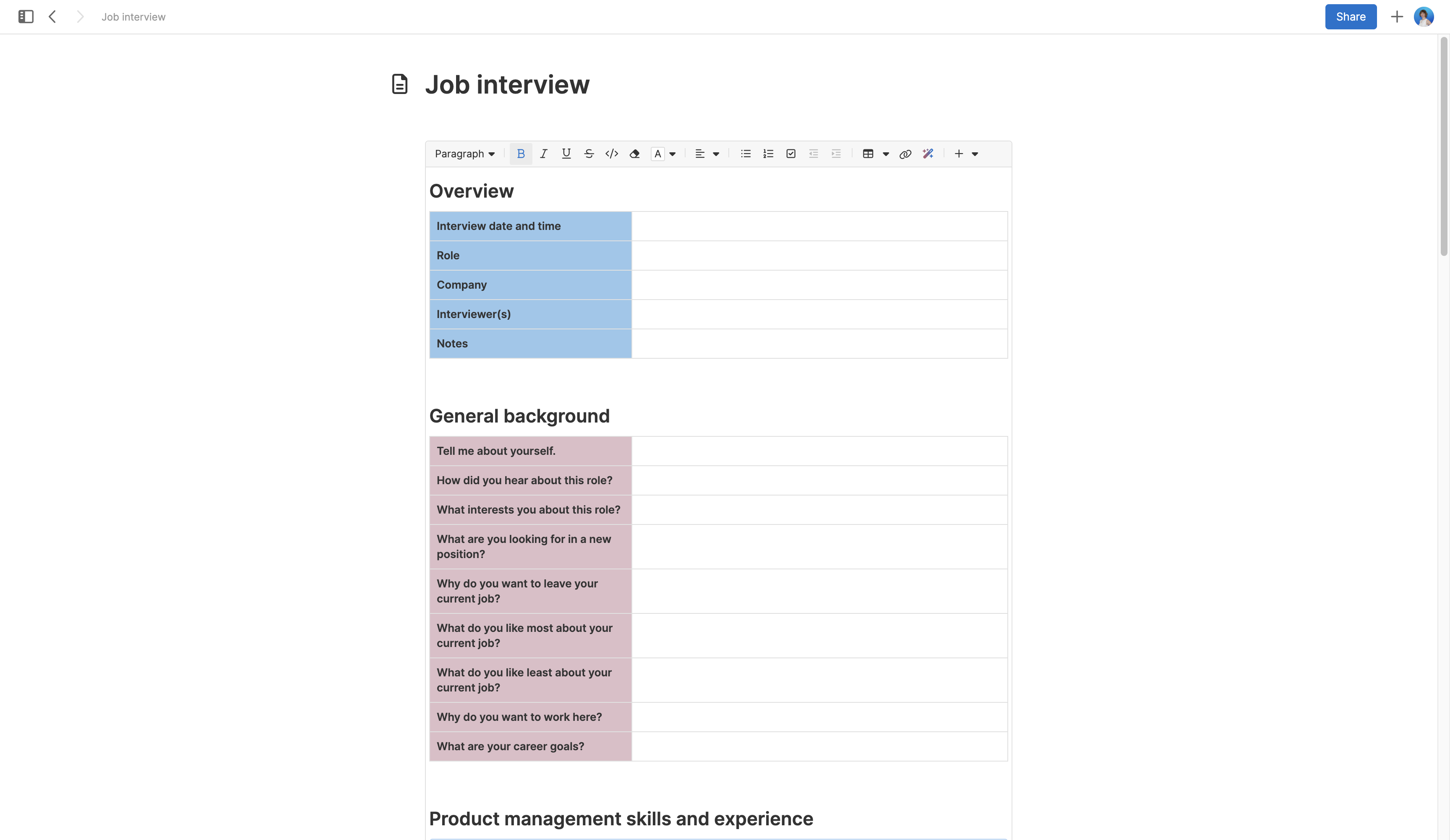
Product manager interview questions vary, but they tend to cover similar themes (including your general background, past experience, and cross-functional leadership skills). Our job interview template is a simple way to get familiar with these topics. It includes 45 practice questions and space to write out responses.
You can also try different product manager interview question frameworks to help formulate well-rounded answers:
DIGS | Dramatize the situation: Emphasize the compelling details and craft a narrative. Indicate the alternatives: Explain how you arrived at the solution you chose. Go through what you did: Describe your efforts in detail. Summarize your impact: Show how your solution provided value to customers or the business.
Learn more about DIGS. |
EAST | Explain: Describe the situation and its significance. Approach: Outline the approach you took, including research or frameworks. Solution: Detail the solution you ultimately implemented. Trade-offs: Discuss any trade-off decisions, challenges, or constraints you faced.
|
Rule of threes | |
SPADE | Situation: Briefly share the scenario. Problem: Define the core problem or challenge you faced. Alternatives: List the different approaches or solutions you considered. Decision: Explain the final decision you made. Evaluation: Share your assessment of the outcome and any lessons you learned.
|
STAR | Situation: Describe the context. Task: Explain your responsibility in the situation. Action: Walk through your approach to solving the challenge. Result: Share the outcomes or results of your actions.
|
These are just a few interview question frameworks. Remember that top tech companies and product manager interviewers are increasingly using those that emphasize structured thinking, customer-centric design, and strategy. For example:
EAST is popular for companies focused on drawing out an applicant's strengths in product design and prioritization.
SPADE is common when an organization needs candidates to demonstrate their ability to assess options and make strategic decisions.
STAR is widely used by interviewers to draw out structured answers that directly highlight the impact a candidate has had in previous roles.
Top
5. Prep your questions for the interviewer
Good product managers are fully immersed in the company strategy and lead the product team to greatness. To be able to achieve this, ensure the organization and product itself are both things you feel driven to support.
Know that you are interviewing the company, too. This is your chance to see how the product development team works and if it truly upholds its values. Prepare questions to ask your interviewers about leadership, processes, and what it is really like to work there. Their responses can clue you in on whether there is mutual alignment. As a plus, asking thoughtful questions like this demonstrates your curiosity — a core trait of excellent product managers.
Related:
Top
6. Practice with mock interviews
What works on paper does not always hold up when spoken aloud. It is always a good idea to practice your responses verbally, and ideally with another person.
Here are a few ideas to help:
Try reaching out to product builders in your network. Ask if they would be willing to do a mock interview with you. You will likely find folks who are happy to help and share their expertise. Welcome any feedback they give to help you improve.
Seek advice through other channels. Check Reddit threads, LinkedIn groups, podcasts, and product management-focused guides and newsletters.
Record yourself. When you listen to the playback, you can identify filler words to avoid, assess your pacing, and recognize where there is room to strengthen your storytelling or more clearly communicate complex points.
Top
7. Get out your notebook
Keep track of your thoughts before, during, and after your interview. In addition to writing out answers to practice questions, it is smart to have a physical or digital notebook handy while interviewing so you can:
Jot down the question being asked and provide an on-topic response.
Document any details the interviewer shares about the role, team, and product to review later.
Remember follow-up information so you know what to expect if you move forward.
If you are in the middle of multiple interview processes with several different companies, it may be worth opting for a digital notebook. That way, information is easily searchable and organized in one place.
Top
8. Prep a whiteboard
You might be asked to work through a problem or exercise during a product manager interview. If you have the opportunity to employ an aid like a whiteboard, take it.
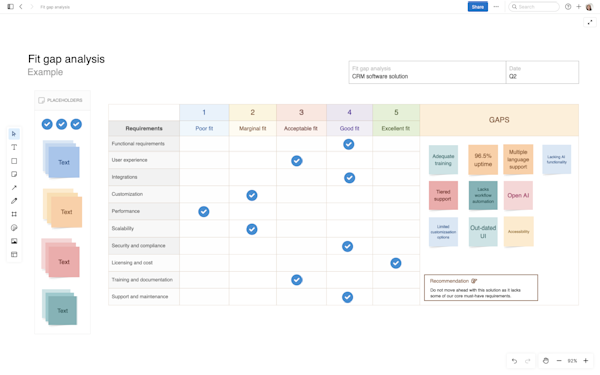
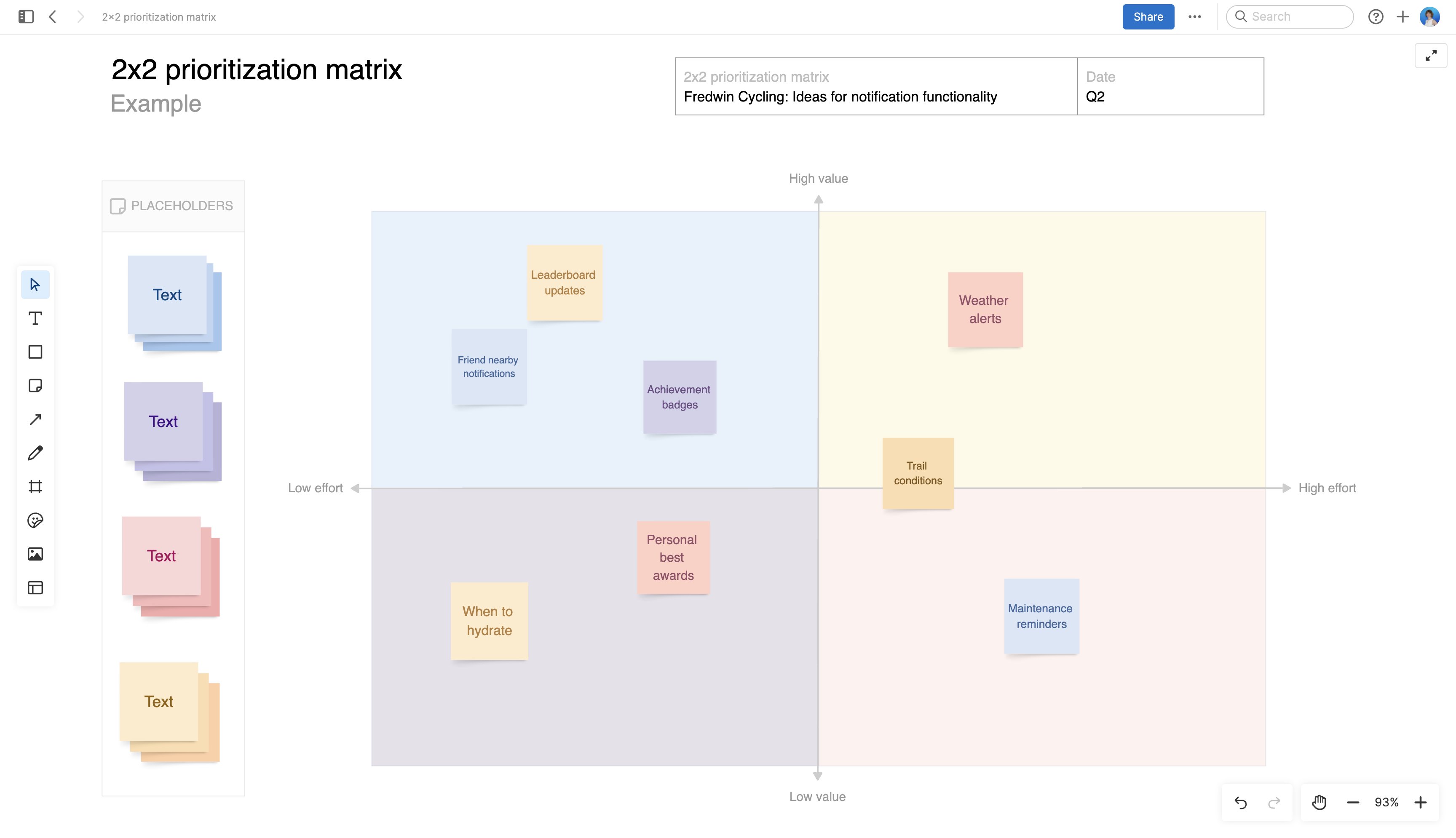
Digital whiteboard diagrams can help you articulate abstract concepts visually and in a way others can clearly understand. Using an interactive tool like this can also highlight your creativity, critical thinking, and ideation — all while making your responses more engaging for the interviewer.
Depending on the tool you use, some whiteboard templates can even aid in demonstrating your knowledge of product management concepts. For example, you could use a 2x2 matrix template to show how you might prioritize features to build. Guided templates can also help keep your narrative focused so you can avoid trailing off into tangents. You can explore some popular product management whiteboard templates here.