Aha! Roadmaps is the complete product management solution. Set strategy, prioritize features, and create beautiful product roadmaps.
Best enterprise product roadmap tools in 2026: How to choose and what to compare


Imagine choosing roadmap software based only on a list of features. Prioritization, roadmaps, reporting, integrations — you could find some of the same capabilities in several products. But knowing that two products have a prioritization feature does not tell you whether (or how) each one supports the product decisions and planning your team needs to do.
Product managers have to determine what is worth building, connect those choices to strategy, and create plans the team can deliver.
Look beyond the roadmap itself when choosing an enterprise roadmapping tool. Consider how well it supports the product decisions and planning behind it.
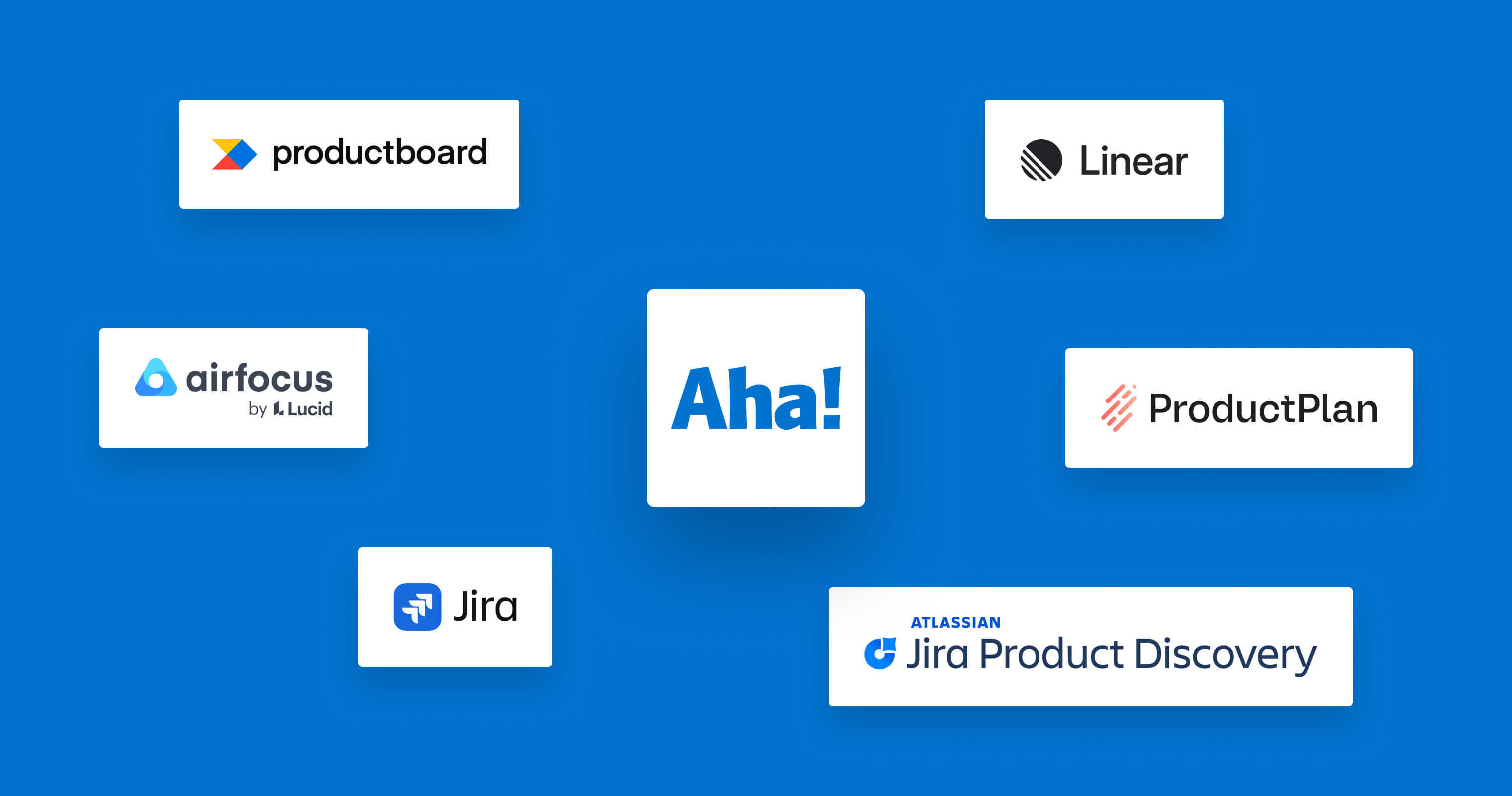
We reviewed six popular options for enterprise product roadmapping: Aha! Roadmaps, Jira Product Discovery and Jira, Productboard, ProductPlan, airfocus, and Linear. All six can produce a roadmap but diverge quickly from there, particularly in how they handle strategy, customer feedback, prototyping, and detailed planning.
We built Aha! Roadmaps, so we know our own software best. We also know it will not be the right choice for every organization. We applied the same criteria to each option and included the trade-offs enterprise teams should consider.
How we compared these options
Enterprise product organizations need more than a way to publish a roadmap. Product leaders are responsible for connecting strategy to plans across a portfolio, while individual teams need to understand customer needs, explore potential solutions, and prepare work for delivery.
Here are the areas we considered when comparing each option:
Does it connect strategy and priorities to product plans?
Goals and strategic initiatives provide a basis for deciding what belongs on the roadmap. We looked at how much structure each option provides for defining that direction and prioritizing against it.
Does it include the ability to collect customer feedback?
Customer evidence belongs in product decisions. We looked at how teams gather and analyze feedback and connect it to potential product work.
What product work can you manage alongside the roadmap?
Teams need to turn roadmap priorities into detailed plans. We looked at how far each option goes beyond high-level roadmap items into requirements, releases, sequencing, and capacity planning.
Can you create prototypes with AI?
Prototyping gives product managers a way to test potential solutions before asking engineering to build them. We explored whether teams can create interactive prototypes and connect them directly to product plans.
Is there a robust AI assistant?
AI can draft text in nearly every product we reviewed. We looked beyond that at how much product work it can complete and whether it can use existing strategy, customer feedback, and plans as context.
Can it support planning across multiple products and teams?
Enterprise product leaders need to coordinate plans across products and teams. We compared product hierarchies, portfolio roll-ups, and cross-team planning.
What can you report on and share?
Roadmaps are one way to communicate product plans. We also compared reporting and dashboards, including how teams can tailor information for different audiences.
Enterprise product planning requires depth at the team level and visibility across the portfolio.
We also considered integrations and setup: how each option works with development software and other systems teams already use, and how much configuration is required to establish and maintain the product model.
Enterprise product roadmap software, compared
Here is a quick look at each tool and the main trade-off enterprise product teams should consider:
Tool | Primary orientation | What enterprise product teams should consider |
Aha! Roadmaps | Comprehensive product management platform, including strategy, product discovery, AI, prototyping, and detailed planning | Deep structure across the product hierarchy might be more than smaller teams need |
Jira Product Discovery + Jira | Product discovery and prioritization connected to an engineering-centered Jira workflow | Strategy and customer feedback are limited; detailed planning requires Jira; no built-in prototyping, and limited AI for product work |
Productboard | Customer feedback as the basis for product decisions | Good feedback management, but less depth in strategy, detailed planning, and portfolio planning; limited AI and no built-in prototyping |
ProductPlan | Creating and communicating roadmap views | Limited strategy, feedback, and detailed planning; minimal AI functionality and no built-in prototyping |
airfocus | Configurable workspaces with portfolio planning | Less depth in strategy and detailed planning; no built-in prototyping; requires more configuration of the planning model |
Linear | Product planning organized around software development projects | Less support for product strategy, customer discovery, and complex portfolio planning; no built-in prototyping |
Aha! Roadmaps
What it is
Aha! Roadmaps is comprehensive product management software for enterprise teams that need to make product decisions and coordinate plans across a portfolio. Product managers can define strategy, bring customer needs into planning, prioritize what to build, and manage ideas, requirements, releases, capacity, and dependencies. You can also assess the product value of what you deliver.
Aha! has grown to more than $100M in annual recurring revenue and more than 1 million users — all while staying bootstrapped and independently owned. For more than a decade, the company has built software that supports the work of product development teams from customer discovery through engineering. That product expertise carries into the customer experience, too: Aha! has no sales team, and former product managers work directly with customers.
Key capabilities
🟢 Strategy and prioritization — Comprehensive: Define vision, business models, positioning, goals, and initiatives across the product hierarchy. Connect strategy directly to planned work and use consistent or customized value scorecards for prioritization.
🟢 Customer feedback — Comprehensive: Aha! Ideas Essentials is included with every Aha! Roadmaps plan, with unlimited ideas portals and users, scorecards, workflows, and reporting. Customer requests stay connected as ideas become planned work.
🟢 Detailed product planning — Comprehensive: Define releases, epics, features, and requirements; plan team capacity; sequence work; and manage dependencies and risks.
🟢 Interactive prototyping — Comprehensive: Create interactive prototypes with Elle, the AI assistant in Aha! software. Save prototypes as records, link them to product work, gather comments, and refine them alongside the plan.
🟢 AI for product work — Comprehensive: Elle works with the product information already in Aha! software. It can analyze data, create and update records, build roadmaps and reports, draft strategy, create prototypes, and connect to approved external tools.
🟢 Portfolio planning — Comprehensive: Organize products in a hierarchy, roll strategy and plans up to company level, and coordinate capacity and dependencies across products and teams.
🟢 Reporting and roadmap views — Comprehensive: Create roadmaps, custom reports, charts, pivots, and dashboards from product data. Analyze information across the hierarchy and share tailored views through presentations and secure webpages.
When it is the right fit
Aha! Roadmaps is built for product organizations that want a consistent way to manage the decisions and plans behind the roadmap. Teams can customize terminology, workflows, fields, scorecards, and views around how their organization operates.
Aha! Roadmaps is part of a suite for product management. Aha! Ideas and Aha! Discovery bring customer feedback and research into planning. Aha! Builder supports proof of concept and application development. Aha! Develop connects product plans with engineering — or teams can integrate Aha! Roadmaps with Jira, Azure DevOps, and other development tools they already use.
Consider another option
Aha! Roadmaps might provide more structure than smaller teams need if they mainly prioritize a short list of work and publish a simple roadmap.
Jira Product Discovery + Jira
What it is
Jira Product Discovery (JPD) is a product discovery and prioritization tool that works alongside Jira. Teams collect insights and ideas, prioritize them, and create roadmap views before committed work moves into Jira for development.
Jira Product Discovery comes from Atlassian, whose software is primarily built for development and IT teams.
Key capabilities
🟡 Strategy and prioritization — Limited: Connect ideas to goals and use custom fields, formulas, and frameworks (such as RICE) to prioritize them. JPD applies strategic context to ideas, but provides less structure for defining product strategy.
🟡 Customer feedback — Limited: Capture customer insights from multiple sources and link them to ideas. Contributors can also vote, comment, and react, but JPD is not a dedicated feedback management system.
❌ Detailed product planning — Separate: JPD handles ideas, prioritization, and roadmaps. Committed work moves into Jira, with additional planning available elsewhere in the Atlassian portfolio.
❌ Interactive prototyping — Not included: JPD does not provide a built-in way to create interactive prototypes.
🟡 AI for product work — Limited: Atlassian AI can help brainstorm, draft, transform, and summarize content in JPD. Its role within product management is narrower than Elle's.
🟡 Portfolio planning — Limited: JPD Premium adds multilevel hierarchies and aggregated roadmaps across projects. Broader planning still spans other Atlassian products.
🟡 Reporting and roadmap views — Limited: Create configurable roadmap, timeline, matrix, and hierarchy views, and publish plans for stakeholders. Broader reporting across planning and delivery depends on other Atlassian products.
When it is the right fit
Jira Product Discovery might be sufficient for teams that primarily need to collect and prioritize ideas before moving committed work into Jira.
Consider another option
Enterprise product organizations that use JPD for discovery and Jira for delivery will manage product work across multiple Atlassian products rather than one product management system.
Productboard
What it is
Productboard is primarily focused on customer feedback and prioritization. Teams collect customer input, connect it to product opportunities, and use it to decide which features to pursue.
In April 2026, Productboard announced plans to reorganize around Productboard Spark as an AI-only company and reduced its workforce by more than 30%.
Key capabilities
🟡 Strategy and prioritization — Limited: Define objectives and initiatives, connect them to features, and prioritize using strategic criteria and customer evidence. The strategic model provides less support for defining product direction.
🟢 Customer feedback — Strong: Centralize feedback, connect insights to product opportunities, identify trends, and compare needs across customer segments. It does not include the breadth of feedback and idea management available in Aha! Ideas.
🟡 Detailed product planning — Limited: Manage features, releases, specifications, and dependencies, with less depth for team capacity and detailed release planning.
❌ Interactive prototyping — Not included: Productboard does not provide a built-in environment for creating interactive prototypes.
🟡 AI for product work — Limited: Spark analyzes feedback, identifies opportunities, and creates product specifications. It does not cover the same breadth of product work as Elle.
🟡 Portfolio planning — Limited: Organize multiple products and create portfolio roadmap views, but separate workspaces cannot be combined into one portfolio roadmap.
🟡 Reporting and roadmap views — Limited: Create roadmaps and reports around features, objectives, customer insights, and progress. Reporting has less depth across detailed planning and complex product portfolios.
When it is the right fit
Productboard might suit teams that primarily want to collect customer feedback and use it to prioritize product opportunities.
Consider another option
Productboard provides less support for teams that also need to define product strategy, plan capacity, prepare releases in detail, and coordinate a complex portfolio. Enterprise buyers should also consider the company's ongoing transition around Spark.
Aha! Roadmaps vs. Productboard
ProductPlan
What it is
ProductPlan is designed primarily for creating and communicating roadmap views. Teams build roadmaps from initiatives and milestones and share them with different audiences.
ProductPlan is owned by private equity firm Bow River Capital. The company also changed its CEO and acquired Winware in 2026.
Key capabilities
🟡 Strategy and prioritization — Limited: Connect roadmap initiatives to objectives and score work for prioritization. ProductPlan does not provide a broader environment for defining product strategy.
🟡 Customer feedback — Limited: Run research surveys and use AI-assisted analysis to review responses. Broader feedback capture is not available.
🟡 Detailed product planning — Limited: Manage initiatives, milestones, and dependencies at the roadmap level. Detailed requirements and team capacity planning need to be managed elsewhere.
❌ Interactive prototyping — Not included: Existing prototypes can be used in research studies, but ProductPlan does not create them.
🟡 AI for product work — Limited: AI is focused primarily on customer research and analysis, with less support for strategy, planning, and other product work.
🟡 Portfolio planning — Limited: Combine multiple roadmaps into portfolio views. These are view-only roll-ups rather than a system for coordinating detailed plans and capacity across products.
🟡 Reporting and roadmap views — Limited: Create timeline, list, table, custom, and portfolio roadmap views for different audiences. ProductPlan provides fewer options for analyzing product data beyond those roadmap views.
When it is the right fit
ProductPlan might be sufficient for teams whose primary need is to create and communicate roadmaps.
Consider another option
Enterprise product organizations that want one system for strategy, customer feedback, detailed planning, capacity, and portfolio coordination will need broader product management capabilities.
airfocus
What it is
airfocus is a configurable product management platform built around connected workspaces for prioritization, feedback, roadmaps, and portfolio planning. Teams configure much of the structure around their own planning model.
airfocus is now owned by Lucid Software, which acquired the previously independent company.
Key capabilities
🟡 Strategy and prioritization — Limited: Define objectives and OKRs, and prioritize work with customizable frameworks. The strategic model is less extensive than Aha! Roadmaps.
🟢 Customer feedback — Strong: Centralize feedback from multiple sources, connect it to product opportunities, collect input through a portal, and use AI to identify patterns and route incoming feedback.
🟡 Detailed product planning — Limited: Manage roadmap items, dependencies, and high-level capacity. Requirements and detailed release planning are more limited.
❌ Interactive prototyping — Not included: airfocus does not provide a built-in environment for creating interactive prototypes.
🟡 AI for product work — Limited: AI can analyze feedback, search and summarize product information, draft product content, and identify changes in strategy and portfolio data. Its MCP server also makes product context available to external AI tools.
🟢 Portfolio planning — Strong: Roll up roadmaps, objectives, dependencies, and capacity across teams and product lines.
🟡 Reporting and roadmap views — Limited: Create configurable roadmaps, dashboards, and views across workspaces.
When it is the right fit
airfocus might suit product organizations that want substantial flexibility and are prepared to define more of their own planning model.
Consider another option
Organizations that want more built-in structure for strategy, requirements, release planning, and prototyping might prefer Aha! Roadmaps rather than establishing and maintaining that structure themselves.
Linear
What it is
Linear is built around software development projects and issues, with product planning closely tied to that work.
Its product management capabilities are organized around the software development process.
Key capabilities
🟡 Strategy and prioritization — Limited: Organize projects under company and team initiatives, assign priorities, and track progress toward objectives. Strategy primarily organizes development projects rather than defining broader product direction.
🟡 Customer feedback — Limited: Capture customer requests manually or through integrations, associate them with customers, and link them to issues and projects. Linear does not provide dedicated customer research or feedback management.
🟢 Detailed product planning — Strong: Define projects, specifications, milestones, dependencies, releases, and issues in detail.
❌ Interactive prototyping — Not included: Linear does not provide a built-in environment for creating interactive product prototypes.
🟡 AI for product work — Limited: Linear Agent can work with workspace and customer context, create and update records, draft specifications, and use connected tools. Much of its AI capability is oriented toward software development and delivery.
🟡 Portfolio planning — Limited: Organize projects under company and team initiatives, including subinitiatives, and roll up progress. There is less structure for managing a complex hierarchy of products and product teams.
🟡 Reporting and roadmap views — Limited: Use timelines, initiative and project updates, and insights to track work and analyze issue data. Reporting is primarily oriented around projects and software delivery.
When it is the right fit
Linear might be sufficient for software teams that want product planning closely tied to development projects and do not need support for customer discovery or product strategy.
Consider another option
Enterprise product organizations that need customer research, product strategy, prototyping, and planning across a complex portfolio will need broader product management capabilities.
How to choose product roadmap software
Nearly every product in this comparison offers prioritization and portfolio roadmaps. Most include some way to capture customer input. Several now promote AI capabilities, too. But each product approaches that work differently.
Aha! Roadmaps takes the most comprehensive approach. Strategy, customer needs, prioritization, detailed plans, and portfolio decisions are all part of the same product management model. Interactive prototyping is built in, and Elle can use the information already captured across Aha! software as context for its work.
Great product managers make sound decisions and create plans their teams can deliver. The right software should help you do both.
Enterprise product organizations need software that can support more than the roadmap people eventually see. Look closely at how your team will decide what belongs on it, prepare the work that follows, and coordinate those plans as the organization grows.
For teams that need that depth across the product development process, Aha! Roadmaps brings the decisions and planning behind the roadmap together in one system.
Set strategy, prioritize features, and create beautiful product roadmaps — try Aha! Roadmaps now.
FAQs about enterprise product roadmap tools
What is the best product roadmap software for enterprise companies?
Enterprise roadmap software should connect strategy, customer feedback, prioritization, detailed planning, and portfolio reporting. Aha! Roadmaps provides the most comprehensive support for that work among the products compared here, including interactive prototyping and AI that works with the product information already captured in Aha! software.
What should an enterprise product team look for in roadmap software?
Start with how your product team works. Can you connect plans to strategy? Bring customer feedback into decisions? Define requirements and releases? Create prototypes before development begins? Then, look at what happens across the organization as you grow — including portfolio planning, reporting, integrations, governance, and the amount of configuration required.
Can product managers and engineers work in the same software?
Yes. A shared product development system can connect product decisions directly to engineering work. Aha! Roadmaps and Aha! Develop are designed to work together this way — so product and engineering teams can work from connected plans without forcing both groups into the same workflows. Teams that use Jira, Azure DevOps, or another development tool can instead integrate it with their product management software.
How should AI factor into choosing product management software?
AI features are becoming standard, but look closely at the product information AI can access and the work it can actually complete. An AI assistant that already understands your strategy, customer feedback, requirements, and plans will take on more product work without requiring you to reintroduce that context with every request. Enterprise teams should also evaluate permissions, security, and governance.
Do enterprise product teams need separate tools for feedback, roadmapping, prototyping, and development?
They do not have to. Keeping feedback, strategy, prioritization, prototypes, and plans connected gives product teams one place to follow an idea from customer need through detailed planning. Engineering teams can work in the same product development system or use a development tool connected through an integration. An important consideration is how much information gets lost or recreated when work passes between systems.